


7 November to 20 December 2026
You're Indian, Aren't You?
Chetan Verma // Anai Bharucha // Danish Mansuri // George Koruth // Zufishan Rahman // Mayuri Kataria // Arbab Kamal Khan
We present an intimate and varied collection of India through the photographers’ eyes, inviting you to consider whatever India may be in your mind.
Hiya Thacker
The Curator's Essay
It was just another 35-degree day in Calcutta. I was driving from Tollygunge to Bhowanipore, a trip that takes twenty minutes on a Sunday afternoon instead of the forty-five it takes on a weekday. I turned into a small lane lined with the usual sellers, fruit, fish, religious goods and mishti. Then I spotted bright pink cups being passed around to strangers. Three or four people stood at the side of the road with trays in their hands, offering a glass to anyone who wanted the pink drink, riders on bikes and scooters, pedestrians, whoever slowed down. I hoped they had a cup for themselves in that heat. When I mentioned it, my mother said it happens outside our building too. She said it so casually. Where I saw a rare kindness, she saw an ordinary Sunday. And that made me happy, I got that humanity is still alive feeling. For me, this is India. It’s the side you don’t see very often, but it is there. I have faith that it always will be there. The exhibition began with its name. You’re Indian, aren’t you?, is something a customer said to me at one of my previous hospitality jobs. Was it even a question? Or was it a statement? The more I thought about it, the more I wondered what it actually means to be Indian. That is where this exhibition started. Since moving to Australia, I have thought constantly about who I am, and my upbringing in India shapes all of it. Living among people from all over India and the world makes you look at your own culture more closely. I’ve become more Indian since I moved here. Growing up, I thought I was whitewashed. Now I want to hold on to my culture as much as I can in a foreign land. At the same time, I don’t want to be defined by where I come from or to define anyone else that way. I think about how I connect with other Indians here. At home, I met people from my city and a handful from around the country. In Australia, I realised that every Indian’s definition of being Indian is different. It’s so varied. We’re taught this in school, in history and geography class, but it only felt real once I moved here. When I began looking for photographers, I saw that each one captured India in their own style and from their own perspective. The final show brings together seven of them, and each offers a different view of the land, the culture, the people, religion, clothing, daily rituals and more. In this room there are seven definitions of what it means to be Indian. I hope that, in the process, you think about what India means to you. I don’t want to leave you with a single definition, because that would defeat the purpose of the exhibition. This is my first time curating a photography exhibition, and I hope it changes something in the way you think. For me, these photographs make me homesick every time I see them.
Chetan Verma

I have been photographing India for almost a decade, mostly on the streets and in the everyday spaces around me. I never really set out to document India or to make a statement about it. I simply enjoy being out with a camera, walking, looking, waiting and seeing what happens. I work as a software engineer, so photography is very different from my day-to-day life. Perhaps that is part of why I enjoy it so much - there are no problems to solve or outcomes to achieve. I can simply walk, look, wait and see what happens. For me, a large part of the joy of photography is the process itself. Sometimes I go out looking for photographs; more often, I just wander and see where the camera takes me. Over time, I have also realised that photography has become a way for me to understand myself a little better. The things I notice, the photographs I choose to make and the way I frame them probably say as much about me as they do about the place I am photographing. The photographs in this selection come from different parts of India and from very different moments. There isn't a particular theme tying them together, and I don't think there needs to be one. They are simply a collection of things I have noticed along the way. India changes so quickly that even places I think I know can look completely different the next time I walk through them. Perhaps that is what keeps me going out with a camera — the feeling that there is still something I haven't seen before. And when a photograph I have enjoyed making connects with someone else, whether through an exhibition, an award or simply someone stopping to look at it, that is probably the most satisfying part of it.
Anai Bharucha

Anai Bharucha is a fashion and documentary photographer based in Mumbai, India. She draws inspiration from human behaviour, spaces, cultures, emotions and the body. She looks to life experiences and small nuances to shape her work and photographs the world as she feels it, not just as it appears. For this exhibition: India is a constantly evolving ecosystem of scale and contrast. It cannot be defined by a singular form or outlook. It is vast and multicultural. It is growing, but at a pace where social and inequality gaps within income groups, caste dynamics, gender roles and the rise of infrastructure at environmental costs become more visible. The series of images displayed here are shot over time during different personal and commissioned assignments. They come together with the use of primary colours and self presentation amongst all subjects. They are the way I see- an attempt to show an honest, real India: still learning its way in a world, still finding its voice.

George Koruth
Everyday India: Between Faith, Ritual and the Ordinary George Koruth’s photographs are drawn from the streets, neighbourhoods and sacred spaces of India, where the extraordinary often exists quietly within everyday life. Working as a documentary photographer, Koruth observes people and places without attempting to separate the spiritual fro the mundane. His photographs look for those fleeting moments when the two naturally meet. Across these images, religion is not presented solely through temples, rituals or acts of devotion. It appears in the textures of daily life: a young pilgrim sitting among worshippers, an elderly man resting beside a painted image of Saraswati, flowers prepared for worship, a barber working beside the river, or a wrestler practising in the earth of an akhara. The sacred becomes part of the architecture of ordinary existence. Koruth is particularly interested in the visual relationships that emerge within these environments, a human figure against a painted deity, a bicycle resting beside an old blue doorway, a body framed by tangled electrical wires, or a wrestler disappearing into the dust of the wrestling pit. Colour, gesture, light and composition become ways of revealing the character of a place. Rather than offering a single interpretation of India, the work embraces its contradictions and layers: ancient traditions alongside modern life, devotion alongside routine, strength alongside vulnerability, and colour alongside quietness. These photographs are ultimately about people and the spaces they inhabit. They are fragments of encounters gathered while walking, waiting and observing, small moments that, when placed together, form a larger portrait of India as a living, constantly changing culture.
Mayuri Kataria
Born and raised in Mumbai, I grew up amidst the city’s relentless pace which sparked my curiosity about life and the world around me. After years of questioning and trying to make sense of it, I turned to photography as a way of exploring what I was looking for. Photography has since become a practice of slowing down and observing, creating an evolving archive of everyday life and the quiet, often overlooked stories within it. This body of work looks at India beyond its familiar images and iconic representations, focusing instead on fragments of everyday life-people, gestures, routines and details that give each place its character. Through these photographs, I explore the space between the monumental and the mundane, capturing encounters that are intimate, ordinary, and sometimes contradictory. Made across diverse landscapes and cultures, the work is a personal record of India as it is lived, not as a singular image, but as a constantly shifting collection of experiences shaped by the people who inhabit it.
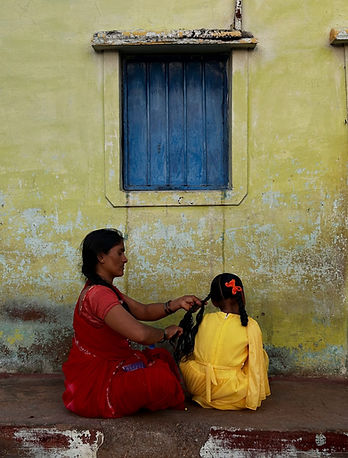

Danish Mansuri
“Sab khel hai perspective ka.” It’s all a matter of perspective. Originally from Burhanpur, Madhya Pradesh, Danish Mansuri is a data analyst by profession and a street and documentary photographer by passion. He finds joy in walking through old city lanes, crowded markets, small towns and villages, observing people and capturing moments that often go unnoticed. For Danish, photography is a way to find calm and silence amid the noise of everyday life. It brings him immense inner joy and allows him to slow down, observe, and connect with the world around him. He often spends time talking to the people he photographs, listening to their stories and discovering the lives behind the faces. His photographs capture everyday India, its people, working communities, traditions, moments of faith, and ordinary scenes that hold something deeper when seen from a different perspective. Guided by his belief that “Sab khel hai perspective ka,” Danish prefers to leave his photographs without taglines or explanations. He wants viewers to interpret each image in their own way, finding meanings and emotions that may be entirely different from his own. For him, a photograph doesn't need to tell people what to think; it simply needs to make them look. Data Analyst by Profession | Street & Documentary Photographer

Arbab Kamal Khan
Arbab Kamal Khan’s photographic practice is an ongoing study of the quieter, more humane traces of beauty and comfort in everyday life. Moving away from spectacle, his work attends to gestures, textures, and the subtle relationships between people and the spaces they inhabit. Rather than photographing happiness or comfort as something to be performed, he is drawn to moments in which these feelings exist without announcement - in familiar surroundings, unguarded gestures, and the ordinary rhythms of being. Rooted in the textures of Indian Muslim cultural life, his work resists idealised representations of lived experience, instead finding beauty in life as it unfolds. Domestic spaces, everyday objects, patterns, and fleeting encounters become sites of quiet observation, revealing the intimacies and sensibilities that often go unnoticed. His photographs invite us to look at the world with a softer gaze, one that moves beyond inherited perceptions to make room for the tenderness, complexity, and ordinariness of lives too often seen through the lens of prejudice. Arbab Kamal Khan is an Indian photographer, filmmaker, and cinematographer from Malihabad, near Lucknow, Uttar Pradesh, India. His photographic sensibility has been shaped by the quieter landscapes of his hometown and the modest, cyclical rhythms of everyday life. Growing up among orchards, country roads, and lived-in neighbourhoods, he developed a fascination with homes, courtyards, and the people who inhabit them, drawn more to the intimacies of ordinary life than to the grandeur of historical monuments. This enduring interest in the lived textures of place continues to inform his practice across photography and cinema.
The Poetry of Unexplained Connections Zufishan Rahman is a visual storyteller and poet based in Bangalore, India. She draws inspiration from everyday moments: the light, the silences, and the small things that hold stories within them. Her work explores memory, identity, beauty and the politics hidden in ordinary life. Her pieces have appeared in The Wire, Nether Quarterly, Aainanagar Magazine, Maktoob Media, Live Wire, Writing Women, Madras Post, and others. Her visual stories have been featured by Homegrown, Somewhere India, India Photo Concept. The human brain is an incurable pattern-seeker. It draws lines between things that have no obvious reason to belong together, finding resemblances where there were none before. This series of diptychs is a little exercise in that instinct. It is an invitation to notice how the world keeps repeating itself in unlikely places. A bindi becomes a moon. A pair of legs finds its counterpart in the trunk of a tree. Clouds grow a beard and a lotus bud looks like a hijab. A dandelion and a scattering of stars ask us to look a little longer. These pairings are not explanations but tiny acts of recognition to tell about the mind’s peculiar appetite for resemblance. Next time you see the red bindi on your mother’s forehead, you might think of the red sun dipping below the horizon at dusk. Your powerful mind will glue these fragments together, helping you appreciate the poetry hidden in everyday life. And yes, everyone should be able to appreciate the poetry of everyday life — because, in the words of Roque Dalton, “Poetry, like bread, is for everyone.”
